
01. Water as theatre
The word comes from the Latin fons, spring. And that is where it starts. The Greeks put wells in their marketplaces and over sacred springs.
The Romans take it further. Aqueducts carry water to raised cisterns, and the drop gives the pressure. Now the water can jet. In villas and pleasure gardens they build grottoes and nymphaea – shrines to the goddesses of water.
The Middle Ages hold on to the well. But in monastery gardens and Moorish palaces the water bubbles. The Court of the Lions fountain at the Alhambra dates from the 13th–14th centuries.
Then it explodes. The Renaissance and Baroque turn water into theatre. Villa d'Este in Tivoli gets hundreds of fountains, cascades and water organs in the 1560s. At Pratolino outside Florence, mechanical figures move and water jokes soak the guests. Rome builds the Trevi Fountain in 1732–1762. Versailles makes the fountain the language of royal power.
And in Prague? In the 1870s the industrialist Moritz Gröbe lays out a garden in the spirit of the Italian Renaissance in Vinohrady. Josef Vorlíček designs an artificial grotto with a fountain. Today it is part of Havlíčkovy sady.
The fountain lives on as a work of art. Stockholm gets Paradiset on Skeppsholmen in 1966, by Jean Tinguely and Niki de Saint Phalle. And since the 1990s the water often jets straight out of the paving.
02. How to spot it
- 1.Water jetting up from a basin or running over bowls
- 2.A sculpture the water pours from – a mouth, a jug, an animal
- 3.A stone basin, often round or many-sided
- 4.Grottoes, cascades and stairs of water in larger gardens
- 5.In the middle of a square or closing a garden axis
03. The giveaway
The pressure. A well is for fetching water. A fountain is for showing it off – the water jets, falls and sounds. It is a performance, not a water supply.
04. Where to see it
- Court of the Lions, Alhambra, Granada13th–14th centuries
- Villa d'Este, Tivoli1564–1572
- Trevi Fountain, Rome1732–1762
- The grotto in Havlíčkovy sady, Praguedesigned by Josef Vorlíček
- Paradiset, Skeppsholmen, Stockholm1966, Jean Tinguely and Niki de Saint Phalle
05. In the app
1 place of this type in Everyday Grandeur. Tap it to see it on the map.
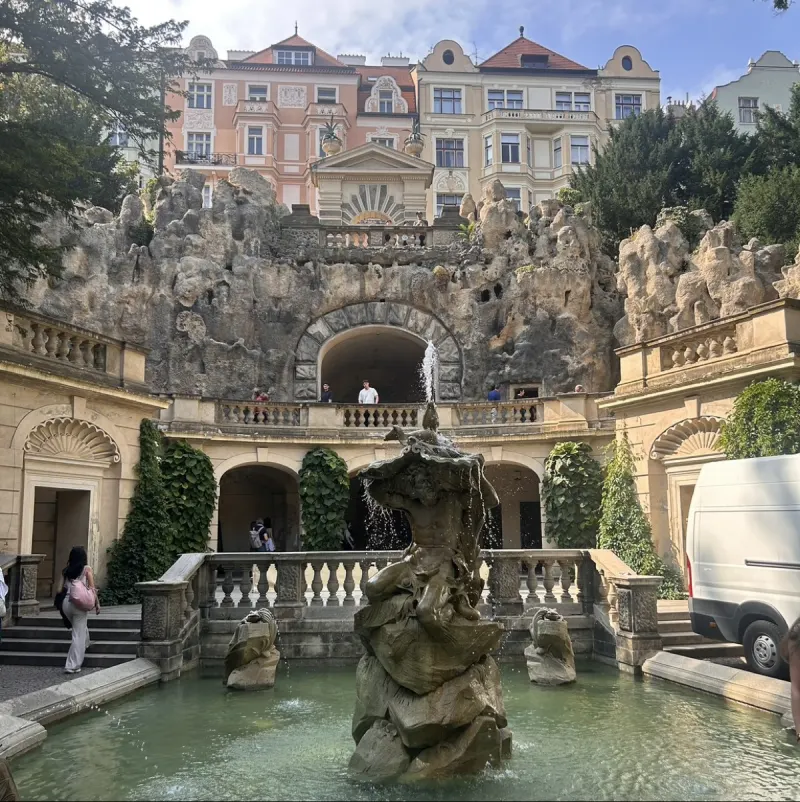 Grotta Umelá jeskyne
06. Often confused with
Obelisk. Both like to stand in the middle of a square. But the obelisk is silent stone. The fountain lives on water.
Sources
- lex.dk (Den Store Danske): "springvand"
- Prague City Tourism (prague.eu): "Havlíček Gardens (Grébovka)"