
01. From emperors to babies
The word comes from the Latin statuere, to set up. A statue is a free-standing sculpture of a human, or something human-like, life-size or larger. A smaller one is a statuette.
Rome, the 170s. Emperor Marcus Aurelius is cast in gilded bronze, on horseback. A ruler high above the people.
Rome, 1538. Pope Paul III has the statue moved from the Lateran to the Capitoline Hill. Michelangelo designs the square around it. Today the original stands indoors, in a hall built for it, and a copy stands out in the square.
But who says it has to be a hero? Prague, 2001. David Černý puts up giant babies crawling up the Žižkov TV Tower. Each one is 3.5 metres long. In 2008 the babies get a permanent home on Kampa too, down by the river.
02. How to spot it
- 1.A human or human-like figure, whole and free-standing
- 2.Life-size or larger
- 3.Stands on a plinth, often with a name and a date
- 4.Bronze, marble, granite – or fibreglass
- 5.Standing, seated or on horseback
03. The giveaway
The plinth. A statue is lifted off the ground and given a place of its own. Read the inscription – it tells you who is to be remembered, and who wanted us to remember.
04. Where to see it
- Equestrian statue of Marcus Aurelius, Romebronze, 170s AD, the original in the Capitoline Museums
- Piazza del Campidoglio, Romethe copy on Michelangelo's square
- Miminka (Babies), Kampa, PragueDavid Černý, permanent since 2008
- Miminka (Babies), Žižkov TV Tower, Praguesince 2001
05. In the app
1 place of this type in Everyday Grandeur. Tap it to see it on the map.
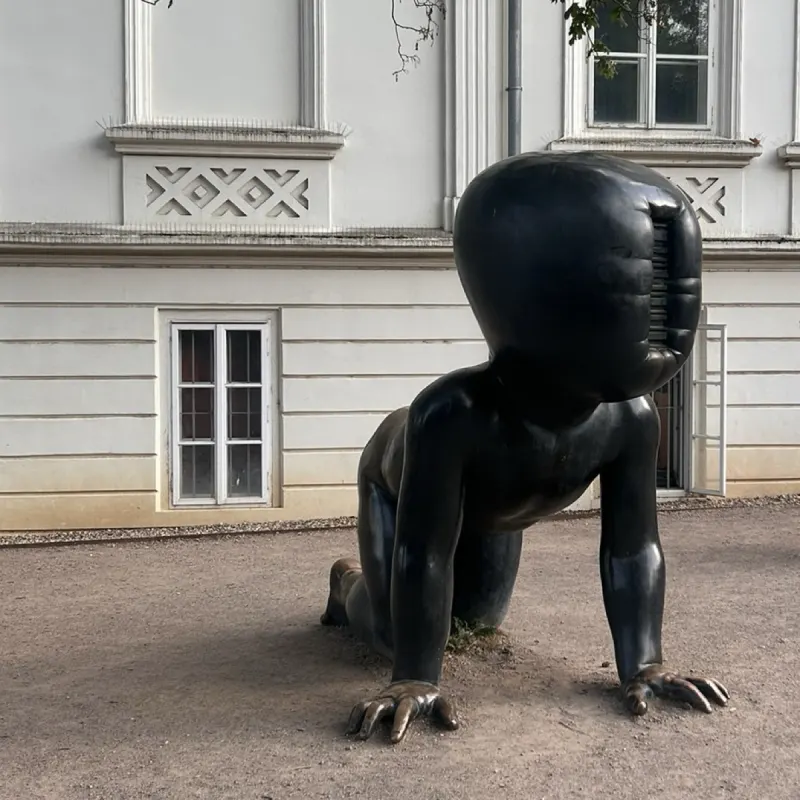 Miminka babies
06. Often confused with
Obelisk. Both stand in the square and remind us of something. But a statue has a face. The obelisk has only its shape and its inscription.
Sources
- lex.dk (Den Store Danske): "statue"
- Musei Capitolini (museicapitolini.org): "Statua equestre di Marco Aurelio"
- David Černý (davidcerny.cz): "Miminka"