
01. The border you cross
The city gate sits in the wall, rampart or fortification around a town. It is where the road crosses the town boundary. The gate can be closed at night and during a siege. It checks who comes in. And it charges: customs and excise on the goods brought in.
So it is also a symbol. Its size and decoration tell you that you are now leaving the countryside and entering the town.
Antiquity already builds them. The Lion Gate at Mycenae gets a large relief above its lintel. Porta Nigra still stands in Trier.
The Middle Ages are the age of walls. Visby gets a ring wall more than three kilometres long, and most of it still stands. Brussels builds a second city wall, finished around 1379. The Porte de Hal is one of its gates.
Then the walls get in the way. Copenhagen demolishes its four gates in the 1850s, when the ramparts go. In Brussels, after 1815, people demand that the Porte de Hal be pulled down – it blocks the traffic. It is saved. The state takes it over in 1842 and turns it into a museum.
But a rescued gate rarely looks the way it did. In 1868–70 the architect Henri Beyaert takes down the upper part of the Porte de Hal and rebuilds it, with a huge roof and a stair tower. The silhouette you see is 19th century.
02. How to spot it
- 1.An arched passage through thick masonry, wide enough for carts
- 2.A tower or gatehouse above it or on each side
- 3.Arrow slits, wall walks or projecting parapets
- 4.Traces of a portcullis or a drawbridge
- 5.Often standing alone, when the wall around it is gone
03. The giveaway
The vault through the building. If you can walk straight through the building, under a heavy vault, on the old road into the centre – you are standing in a city gate.
04. Where to see it
- Porte de Hal, Brusselspart of the second city wall, finished around 1379, rebuilt 1868–70
- Visby city wallmore than three kilometres, World Heritage Site since 1995
- Porta Nigra, Trier
- The Lion Gate, Mycenae
- Mølleporten, Stege, Denmarkprobably late 15th century
05. In the app
1 place of this type in Everyday Grandeur. Tap it to see it on the map.
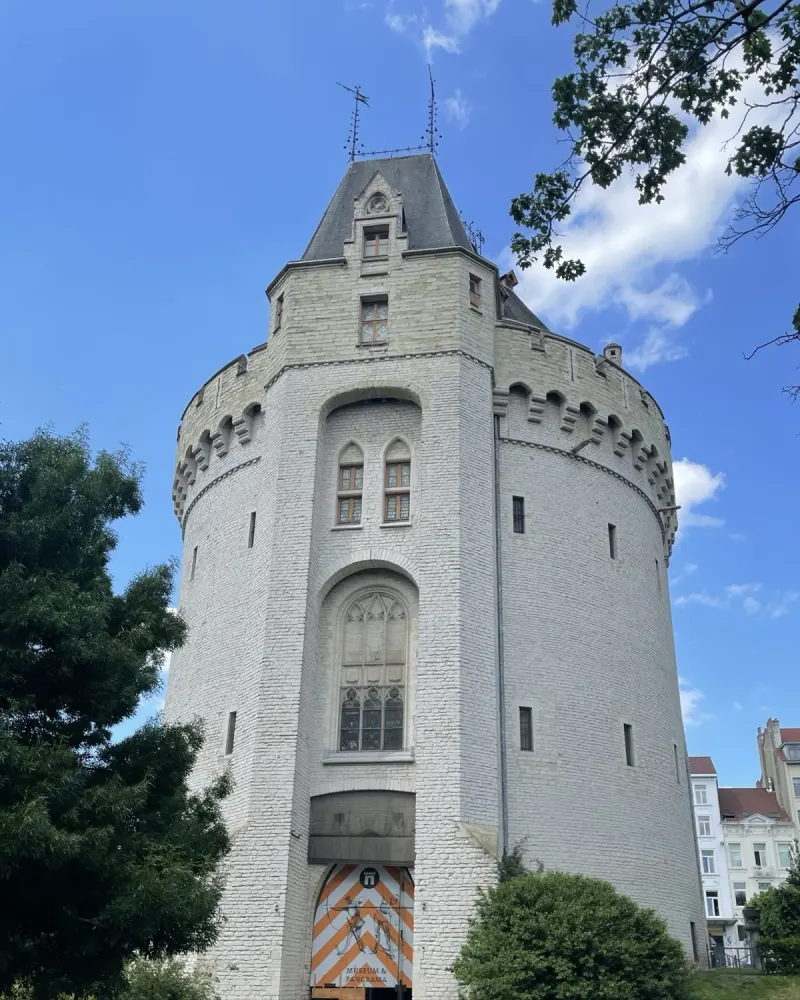 Porte de Hal
06. Often confused with
Gothic Revival. Many city gates are restored in the 19th century and given battlements, roofs and towers that were never there. The Porte de Hal is a good example: a medieval core in a Gothic Revival costume.
Gothic. The genuine medieval gate is often plainer than you think – heavy, practical and built to defend, not to impress.
Sources
- lex.dk (Den Store Danske): "byport"
- lex.dk (Den Store Danske): "Visby"
- Bruxelles Patrimoines no. 2 (June 2012): "La Porte de Hal", Brussels-Capital Region