
01. A great power builds
The Thirty Years' War is over and Sweden is a great power. The nobility and the crown build to prove it. Architects and craftsmen are brought in from France, the Netherlands and Italy, and before long Sweden has world-class architects of its own.
The House of Nobility in Stockholm is built in 1641–1674 by a succession of architects: Simon de la Vallée, Justus Vingboons and finally Simon's son Jean de la Vallée, who gives it its characteristic broken sateri roof. Nicodemus Tessin the Elder designs both Drottningholm Palace, begun in 1662, and Kalmar Cathedral, built 1660–1703.
His son, Nicodemus Tessin the Younger, takes over when the castle of Tre Kronor burns in 1697. His new Royal Palace in Stockholm becomes one of the great Baroque palaces of Europe.
02. How to spot it
- 1.Monumental, symmetrical façades with an emphasised centre
- 2.Sateri roof – a broken roof with a low band of windows between the slopes
- 3.Pilasters and columns in the classical orders
- 4.Palace, wings and garden along one long axis
- 5.Inside: stucco, acanthus leaves and twisted columns
03. The giveaway
The wall anchors. In the 17th century the irons that hold the masonry together gain scrolls, leaves and hearts. On the Stenbock Palace on Riddarholmen, anchors from the 1670s are still in place.
Read the façade
- The dome
- The lantern on top
- Pilasters in a classical order
- Symmetry around the central axis
04. Architects and builders
- Simon de la Vallée
- Jean de la Vallée
- Justus Vingboons
- Nicodemus Tessin d.ä
- Nicodemus Tessin d.y
05. Where to see it
- The House of Nobility, Stockholm1641–1674
- Drottningholm Palacebegun 1662, World Heritage since 1991
- Kalmar Cathedral1660–1703
- The Royal Palace, Stockholmbegun 1697
06. In the app
5 places in this style in Everyday Grandeur, added by the app's users. Tap a place to see it on the map.
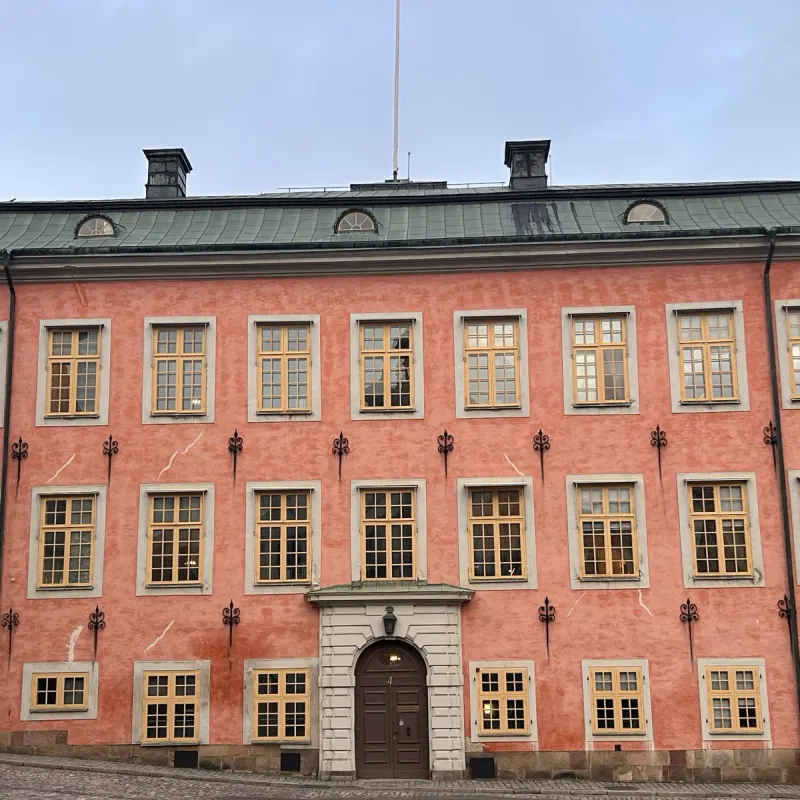 Stenbockska PalatsetStockholm · 1640 · Nicodemus TessinPhoto: @Pontus
- Santuario de la Virgen de la Velilla 1615 · Domingo de LastraAdded by: @aleserre
- Casa de la Inquisición Valdemoro · 1650Added by: @aleserre
- Baku City Executive PowerBakı · 1900 · Józef GosławskiAdded by: @PrussianPerson
- St James Theatre Wellington · 1912Added by: @Hanoian
07. Often confused with
Neo-Baroque. The 1890s version. The Royal Opera in Stockholm (1898) and the Riksdag building look Baroque but belong to the turn of the century.
Sources
- Svenska kyrkan, Folkungabygdens församling: "Stilar och epoker"
- Pontus Bovin: Bakom fasaden – ankarslutens gömda konstruktion och syfte (Uppsala universitet, Campus Gotland, 2024), med Bo Molander: Järn i gamla byggnader (1985)
- Swedish Wikipedia: "Riddarhuspalatset", "Drottningholms slott", "Kalmar domkyrka", "Stockholms slott"