
SVEN
The app is free

Find the places on the map, check in and collect badges.

Architectural style · From the 1980s

Deconstructivism

Dekonstruktivism

Leaning walls, roofs that split open, buildings that seem to have stopped mid-fall. Deconstructivism breaks the box – on purpose.

The style in timeDrag to travel in time

  1. Zigguratc. 2200–500 BC
  2. Ancient Greek architecturec. 700–30 BC
  3. Roman architecturec. 500 BC–AD 400
  4. Nabataean architecturec. 300 BC–AD 106
  5. Byzantine architecturec. 330–1453 in the Eastern Roman Empire
  6. Moorish architecture8th–15th century in al-Andalus and North Africa
  7. Carolingian architecturec. 780–900 in the Frankish Empire
  8. Novgorod and Pskovc. 1045–1600 in north-western Russia
  9. Norman architecturec. 1050–1200
  10. Romanesquec. 1050–1250
  11. Mudéjarc. 1100–1600
  12. Gothicc. 1235–1530
  13. Brick Gothicc. 1250–1530
  14. Late Gothicc. 1400–1530
  15. Manuelinec. 1490–1530
  16. Renaissancec. 1520–1650
  17. Palladian architecturec. 1550–1800
  18. Dutch Renaissancec. 1560–1650 in the Netherlands and Flanders
  19. Baroquec. 1640–1730
  20. Carolean Baroquec. 1680–1720
  21. Georgian architecture1714–1830
  22. Rocococ. 1730–1775
  23. Neoclassicismc. 1750–1850
  24. Gustavianc. 1772–1810
  25. Karl Johan stylec. 1810–1850
  26. Victorian architecture1837–1901
  27. Gothic Revivalc. 1840–1910
  28. Historicismc. 1840–1900
  29. Industrial architecturec. 1850–1950
  30. Neo-Renaissancec. 1850–1900
  31. Swiss chalet stylec. 1850–1900
  32. Landshövdingehus1875–1945
  33. Neo-Baroquec. 1880–1910
  34. Beaux-Artsc. 1830–1920
  35. National Romanticismc. 1890–1920
  36. Art Nouveauc. 1896–1914
  37. Art Decoc. 1910–1940
  38. 1910s Neoclassicismc. 1910–1920
  39. Bauhaus1919–1933
  40. Swedish Gracec. 1920–1930
  41. Functionalismc. 1930–1950
  42. Socialist classicismc. 1933–1955
  43. Post-war Swedish modernismc. 1940–1960
  44. Brutalismc. 1950–1975
  45. The Record Yearsc. 1955–1975
  46. The Million Programme1965–1974
  47. DeconstructivismFrom the 1980s
  48. Postmodernismc. 1980–1995
  49. LonghouseStone Age to Viking Age
  50. Log houseThe Middle Ages onwards
  51. Raised storehouseIron Age to 20th century
  52. Swedish vernacularc. 1600–1900
  53. Croft and cottagec. 1700–1900
  54. Decorated farmhouses of Hälsinglandc. 1700–1900
  55. Half-timberingThe Middle Ages to the 19th century
  56. Sámi goahtiFrom prehistory to the present day
  57. Seljuk architecturec. 1040–1300
  58. Persian architectureIran
  59. British Colonialc. 1700–1950 in the British Empire

01. Controlled chaos

Paris, 1982. The city holds a competition for a park on the old slaughterhouse grounds at La Villette. Bernard Tschumi wins. He scatters red pavilions across the grass, as if someone has dropped a construction kit.

Then comes the exhibition. In 1988 the Museum of Modern Art in New York shows Deconstructivist Architecture, curated by Philip Johnson and Mark Wigley. Seven names: Frank Gehry, Zaha Hadid, Daniel Libeskind, Rem Koolhaas, Peter Eisenman, Coop Himmelb(l)au and Tschumi. A movement has a name.

The name is borrowed in two parts. From Russian Constructivism come the tilted planes and flying beams. From the philosopher Jacques Derrida comes the word deconstruction – taking apart the obvious. But the style doesn't look broken by accident. Every slanted wall is calculated.

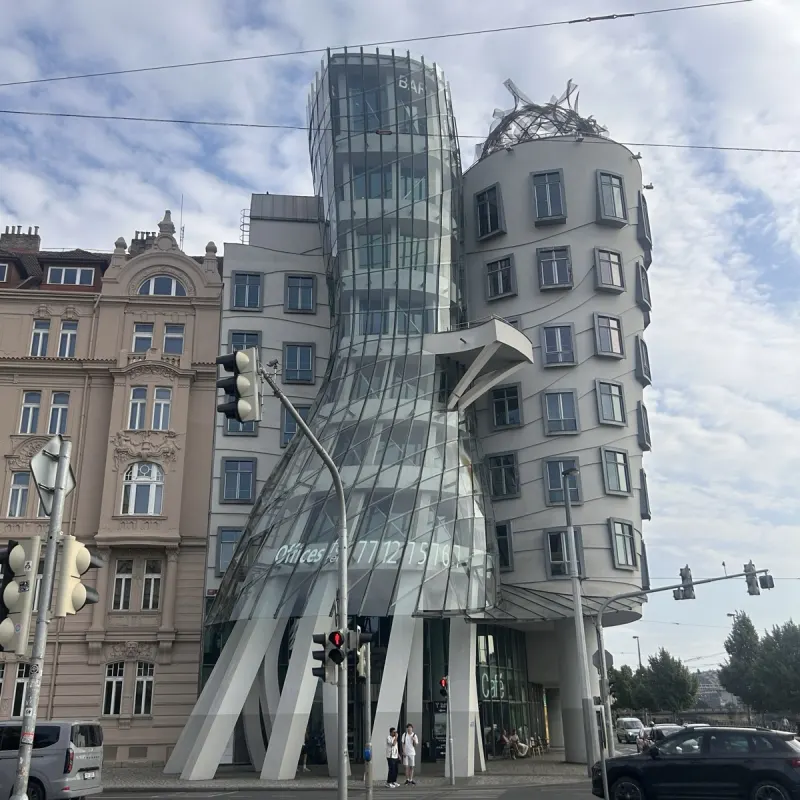
The 1990s bring the breakthrough. Zaha Hadid's fire station for Vitra is finished in 1993, like a bundle of concrete blades. In Prague a house dances on the embankment in 1996. The year after, the Guggenheim Museum opens in Bilbao, clad in thin titanium – and a whole city gets a new face. In Berlin, Libeskind's Jewish Museum zigzags like lightning, with voids that cut straight through the building.

Was it even a style? The architects themselves often said no. But the form is unmistakable.

02. How to spot it

  • 1.Slanted walls and leaning columns – no right angles where you expect them
  • 2.Volumes that project, break or collide
  • 3.Façades of metal, glass or titanium, often curved
  • 4.No symmetry and no clear front or back
  • 5.The structure is shown off – or deliberately hidden

03. The giveaway

The corner. A corner that doesn't meet at a right angle – where the walls lean, slide past each other or fold like paper – is the signature of Deconstructivism.

04. Architects and builders

  • Frank Gehry
  • Zaha Hadid
  • Daniel Libeskind
  • Peter Eisenman
  • Bernard Tschumi
  • Rem Koolhaas
  • Coop Himmelb(l)au
  • Vlado Milunić

05. Where to see it

  • Parc de la Villette, ParisBernard Tschumi, competition 1982
  • Vitra Fire Station, Weil am RheinZaha Hadid, 1993
  • Dancing House, PragueVlado Milunić and Frank Gehry, 1996
  • Guggenheim Museum, BilbaoFrank Gehry, 1997
  • Jewish Museum, BerlinDaniel Libeskind, opened 2001

06. In the app

1 place in this style in Everyday Grandeur. Tap it to see it on the map.
07. Often confused with

Postmodernism. Both break with Modernism, but in different ways. Postmodernism quotes history – columns, pediments, colour. Deconstructivism quotes nothing; it takes the form itself apart.

Sources

  • Wikipedia (en): "Deconstructivism"
  • Wikipedia (en): "Dancing House"
  • Wikipedia (en): "Guggenheim Museum Bilbao"
  • Wikipedia (en): "Jewish Museum Berlin"
  • Vitra: "Fire Station" (vitra.com)

Deconstructivism around the corner

Everyday Grandeur is a living map of the heritage in your everyday life. Find the style near you, check in and collect badges – free for iPhone and Android.