
01. Antiquity is dug up
It is the mid-18th century, and beneath the ash of Vesuvius lie two Roman towns. Herculaneum and Pompeii are being excavated, lavish volumes of the finds spread across Europe, and the German art historian Johann Joachim Winckelmann praises the "noble simplicity and quiet grandeur" of Greek art. Suddenly the Rococo feels overdone.
The new style first takes Rome as its model. The Panthéon in Paris is built in 1758–1790, and in Berlin Carl Gotthard Langhans raises the Brandenburg Gate in 1791. Around 1800 a second wave arrives as knowledge of the Greek temples grows – the Greek Revival. Karl Friedrich Schinkel's Altes Museum in Berlin is finished in 1830, and in London the British Museum is built in 1823–1847. Across the Atlantic the style becomes the language of the young republic, from the Capitol in Washington to Thomas Jefferson's Rotunda at the University of Virginia, 1826.
In Sweden, Neoclassicism becomes the Gustavian style. The Stock Exchange Building on Stortorget, designed by Erik Palmstedt and built in 1773–1778, is one of the earliest Swedish examples. In the first decades of the 19th century a heavier Empire style takes over – in Sweden the Karl Johan style.
02. How to spot it
- 1.Columns and pilasters in the classical orders – Doric, Ionic, Corinthian
- 2.Temple fronts – pediments – over entrances and façades
- 3.Strict symmetry and simple geometric volumes
- 4.Smooth, light façades with ornament held in framed panels and friezes
- 5.Domes and rotundas after Roman models
03. The giveaway
The columns. If they are smooth, stand in pairs or rows in front of a calm, symmetrical façade and carry a pediment, the architect has read up on antiquity.
Read the façade
04. Architects and builders
- Jacques-Germain Soufflot
- Robert Adam
- Claude Nicolas Ledoux
- Karl Friedrich Schinkel
- Benjamin Henry Latrobe
- Thomas Jefferson
- Erik Palmstedt
05. Where to see it
- The Panthéon, Paris1758–1790
- The Brandenburg Gate, Berlin1791
- The Altes Museum, BerlinKarl Friedrich Schinkel, 1825–1830
- The British Museum, LondonRobert Smirke, 1823–1847
- Kedleston Hall, DerbyshireRobert Adam, 1760–1770
- The Stock Exchange Building, StockholmErik Palmstedt, 1773–1778
06. In the app
3 places in this style in Everyday Grandeur, added by the app's users. Tap a place to see it on the map.
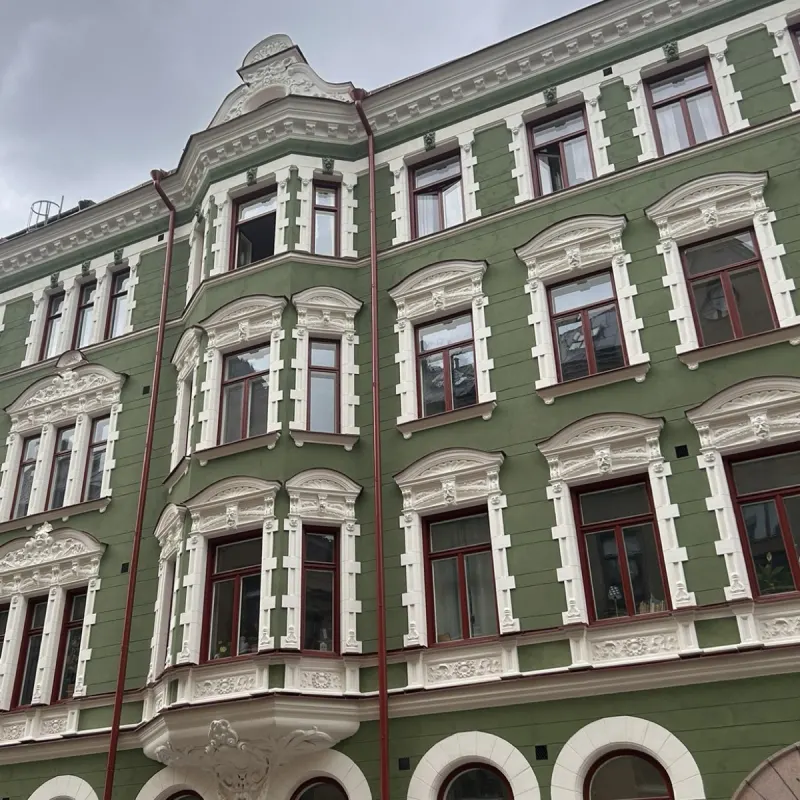 Skeppargatan 41
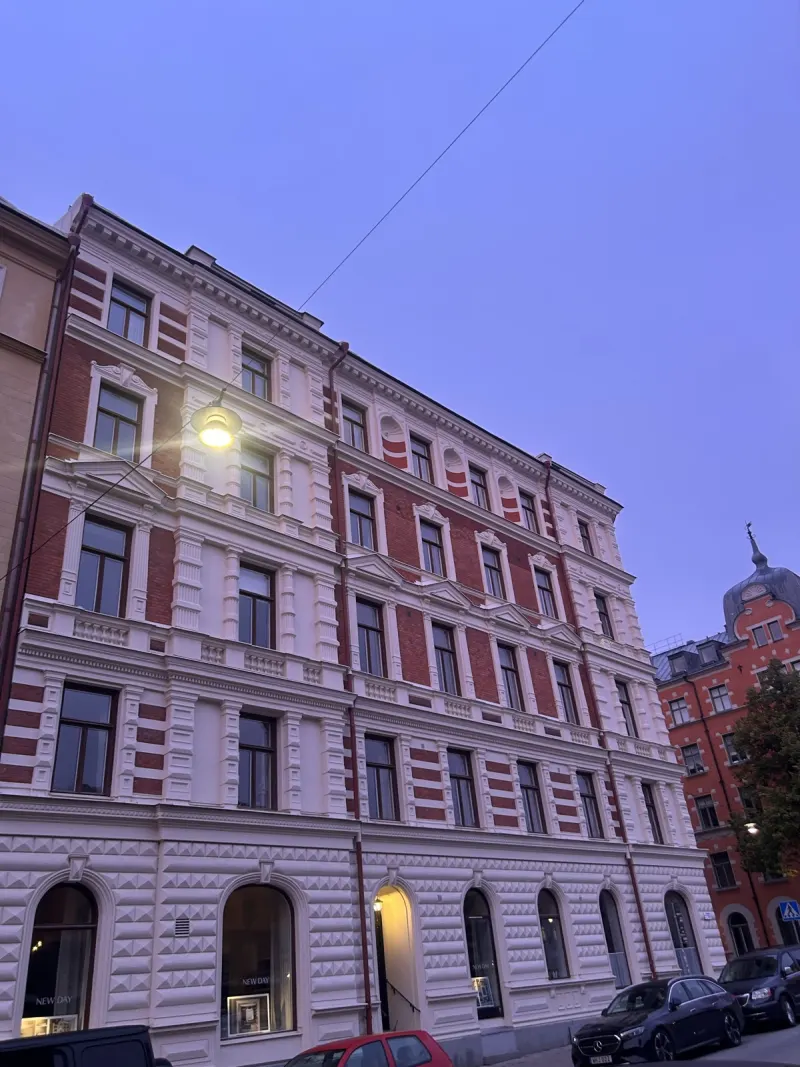 Storgatan 42
07. Often confused with
Gustavian. The Swedish version of the same movement – usually smaller in scale, with lighter, more graceful details. Palladian. Older: Palladio's 16th-century villas founded a tradition of their own in England before Neoclassicism.
Sources
- Wikipedia (en): "Neoclassical architecture" (bygger bl.a. på Robin Middleton & David Watkin: Neoclassical and 19th Century Architecture, 1993, och Hugh Honour: Neo-classicism, 1968)
- Wikipedia (en): "Stockholm Stock Exchange Building"
- Owen Hopkins: Reading Architecture – A Visual Lexicon, andra upplagan (Laurence King)
- Svenska kyrkan, Folkungabygdens församling: "Stilar och epoker"