01. Italy in brick
Antwerp, 1560. The trading city wants a new town hall – and it has to show. A committee of artists draws the plans. Cornelis Floris de Vriendt leads the works, and in 1565 the building is inaugurated.
The façade is something new. The Gothic building tradition meets the Italian orders of columns – for the first time in the Low Countries. Doric on one floor, Ionic on the next. In the middle rises a tall gable, half Roman portico, half medieval town-hall tower.
Eleven years later it burns. During the Spanish Fury of 1576 the city is sacked, and only the outer walls survive. But the forms have already started to travel.
They travel in books. In 1577 Hans Vredeman de Vries publishes Architectura in Antwerp – plate after plate on the five orders, with columns, capitals and ornament ready to copy. It is printed in German, French and Dutch. Craftsmen north of the Alps get a pattern book in their hands.
Then the centre moves north. Haarlem, 1602: city architect Lieven de Key designs the Vleeshal, the town's meat hall. The stepped gable is loaded with sandstone and obelisks. Stone heads of oxen and sheep tell you what was sold inside. Amsterdam, 1603: Hendrick de Keyser starts on the Zuiderkerk. Then the Westerkerk.
And the style is exported. Kronborg on the Øresund is rebuilt in 1574–1585 by Dutch architects – Hans van Paeschen, then Anthonis van Obbergen. Right across the Sound from Helsingborg, the style stands in Danish dress.
But the story doesn't end there. In the 19th century young Belgium needs a national style – and finds it in its own Renaissance. Neo-Flemish Renaissance flourishes from the 1850s–70s, first in Brussels and Antwerp. In Bruges old gables are restored and new ones drawn in the same spirit – from 1877 in the city's own "artistic restorations". Not every gable that looks 16th-century is.
02. How to spot it
- 1.Red brick with white bands of sandstone – in Dutch speklagen, bacon layers
- 2.Tall gables that curve in and out, often crowned by a small pediment
- 3.Strapwork – flat, winding bands that look cut from leather or sheet metal
- 4.Cross-mullioned windows, often with leaded glass above and shutters below
- 5.Obelisks, mascarons, satyrs and decorated wall anchors on the façade
03. The giveaway
Speklagen. Stripes of pale stone through a red brick wall – like bacon in cross-section. Add a gable curling in volutes, and you are looking at Dutch Renaissance. Or at the 19th century's copy of it.
04. Architects and builders
- Cornelis Floris de Vriendt
- Hans Vredeman de Vries
- Lieven de Key
- Hendrick de Keyser
- Hans van Paeschen
- Anthonis van Obbergen
05. Where to see it
- Antwerp City Hall1561–1565, Cornelis Floris de Vriendt
- Kronborg, Helsingør1574–1585, World Heritage Site since 2000
- Vleeshal, Haarlem1602–1603, Lieven de Key
- Zuiderkerk, Amsterdam1603–1611, tower completed 1614, Hendrick de Keyser
- Westerkerk, Amsterdam1620–1631, Hendrick de Keyser
- De Grote Vos, Steenstraat 25, Brugesthe masons' guild house, gable dated 1625
06. In the app
2 places in this style in Everyday Grandeur, added by the app's users. Tap a place to see it on the map.
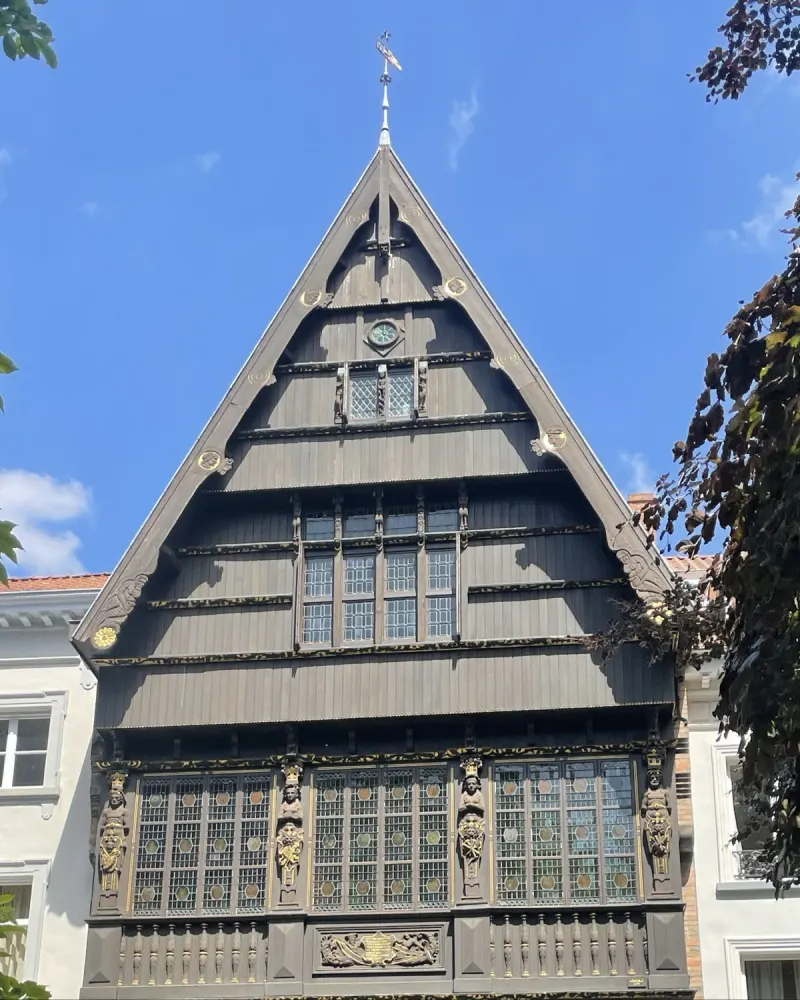 Lucas-Huys
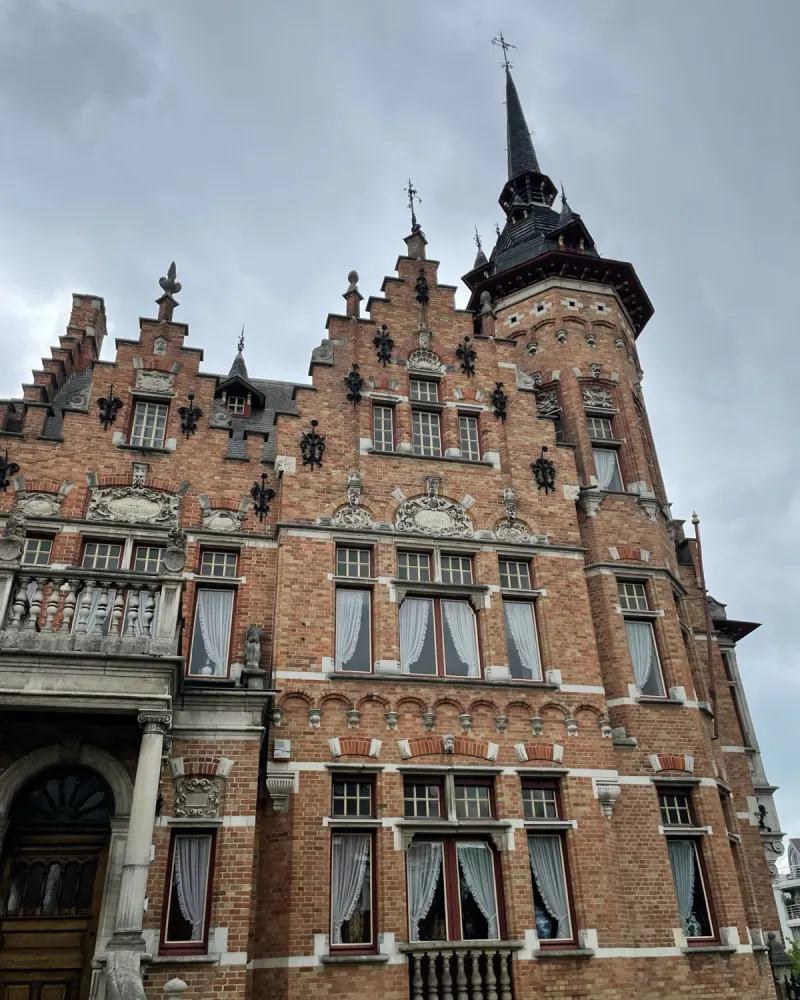 Huis Lanceloot Blondeel (Stadskasteeltje)
07. Often confused with
Neo-Renaissance. The 19th century borrows freely from these gables. In Belgium it is called Neo-Flemish Renaissance. The Lucas-huys in Bruges looks as if it were from 1573 – but it is a wooden gable from Brussels, moved and rebuilt in 1889–90. Huis Lanceloot Blondeel a few blocks away dates from 1909.
Renaissance. Sweden's Vasa Renaissance borrows a lot from the Netherlands, especially in the early 17th century. But castles with round corner towers are something of their own. The Dutch style is above all urban: town halls, guild houses, meat halls and churches.
Sources
- Onroerend Erfgoed (Flanders), thesaurus: "renaissance" and "neo-Vlaamserenaissance-stijl"
- Inventaris Onroerend Erfgoed: "Stadhuis van Antwerpen" (Grote Markt 1)
- Inventaris Onroerend Erfgoed: "Gildehuis De Grote Vos", "Burgerhuis Lucashuys", "Herenhuis Lanceloot Blondeel" (Bruges)
- Rijksdienst voor het Cultureel Erfgoed, Rijksmonumentenregister: Vleeshal, Haarlem (no. 19262); Zuiderkerk (no. 6498) and Westerkerk (no. 4298), Amsterdam
- Architectura – Architecture, textes et images (Université de Tours, CESR): Hans Vredeman de Vries, Architectura, 1577
- lex.dk (Den Store Danske): "Kronborg"