
01. Graceful, light and Swedish
In the 1920s a light, graceful classicism dominates Nordic architecture. It takes its ideals from the late 18th century but interprets them freely – slender proportions, smooth surfaces and small, precise details. The English critic Morton Shand names the style "Swedish Grace" in the Architectural Review in 1931.
The great works stand in Stockholm. Ivar Tengbom's Concert Hall is completed in 1926 and Gunnar Asplund's Public Library – a cylinder on a cube – in 1928. At the Woodland Cemetery, Sigurd Lewerentz designs the Resurrection Chapel, completed in 1925 and one of the purest buildings of the style. Tengbom's Match Palace from 1928 and Götaplatsen in Gothenburg belong here too.
It is also the first decade of the "people's home". Per Albin Hansson launches the term, the HSB housing co-operative is founded in 1923, and a good home is to be within everyone's reach. One room and a kitchen with the new kitchenette – but with central heating, hot water, a bathroom and a laundry room.
Buildings become simpler. In Stockholm the permitted ceiling height drops in 1919 from three to 2.7 metres, façades turn straight and smooth and the windows identical, one per room. The danger is monotony – the answer is colour. Façades are smoothly rendered in saturated yellow, red, grey or muted green, and the ornaments are placed sparingly in pale grey-white: a dentil frieze here, a festoon or rosette there. At the top, a recessed "king's floor", built by special royal dispensation. At the corners of the blocks, powerful gables rise – pediments, curving Baroque gables, stepped gables. Röda Bergen, Atlasområdet and Rörstrandsområdet are built in this spirit. The ideal? The small Swedish town.
In Gothenburg the style also shows in the late landshövdingehus. Symmetry returns, the dark colours of National Romanticism give way to light ones, and whole blocks are built in a uniform dress with six-paned windows. Swedish Grace is also a furniture, glass and crafts style. At the end of the 1920s Functionalism takes over – and several of its architects, Asplund above all, make the leap themselves.
02. How to spot it
- 1.Classical proportions but stripped-down forms
- 2.Smooth, light rendered façades in yellow, pink or white
- 3.Small, precise details: slender columns, niches, reliefs
- 4.Geometric basic forms – cubes and cylinders
- 5.Lavish, artistically decorated interiors
- 6.Two-light windows with three equal panes in each sash, set close to the wall face
- 7.A recessed "king's floor" above the eaves
- 8.A tall, centred portal with a stone surround, glazed doors and a barred fanlight
03. The giveaway
The window. The typical 1920s window has two lights with three equal panes in each – six panes – set in even rows close to the wall face. If you see it in a smooth, richly coloured façade with a single festoon or rosette, you are in the 1920s.
Read the façade
- A recessed top floor
- A thin cornice
- Slender, precise columns
04. Architects and builders
- Gunnar Asplund
- Sigurd Lewerentz
- Ivar Tengbom
- Carl Bergsten
- Cyrillus Johansson
- Sigfrid Ericson
- Arvid Bjerke
05. Where to see it
- Stockholm Public Library1928
- The Concert Hall, Stockholm1926
- The Resurrection Chapel, Woodland Cemetery, Stockholm1925
- The Match Palace, Stockholm1928
- Götaplatsen, Gothenburg
- Röda Bergen, Stockholm1920s housing blocks
06. In the app
3 places in this style in Everyday Grandeur, added by the app's users. Tap a place to see it on the map.
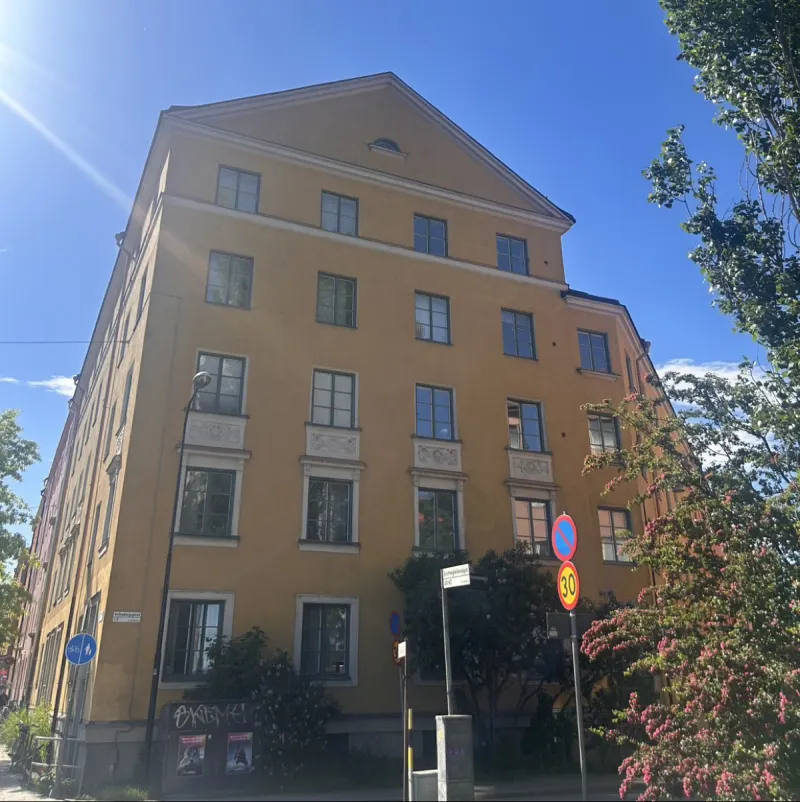 Gyllenborgsgatan 1
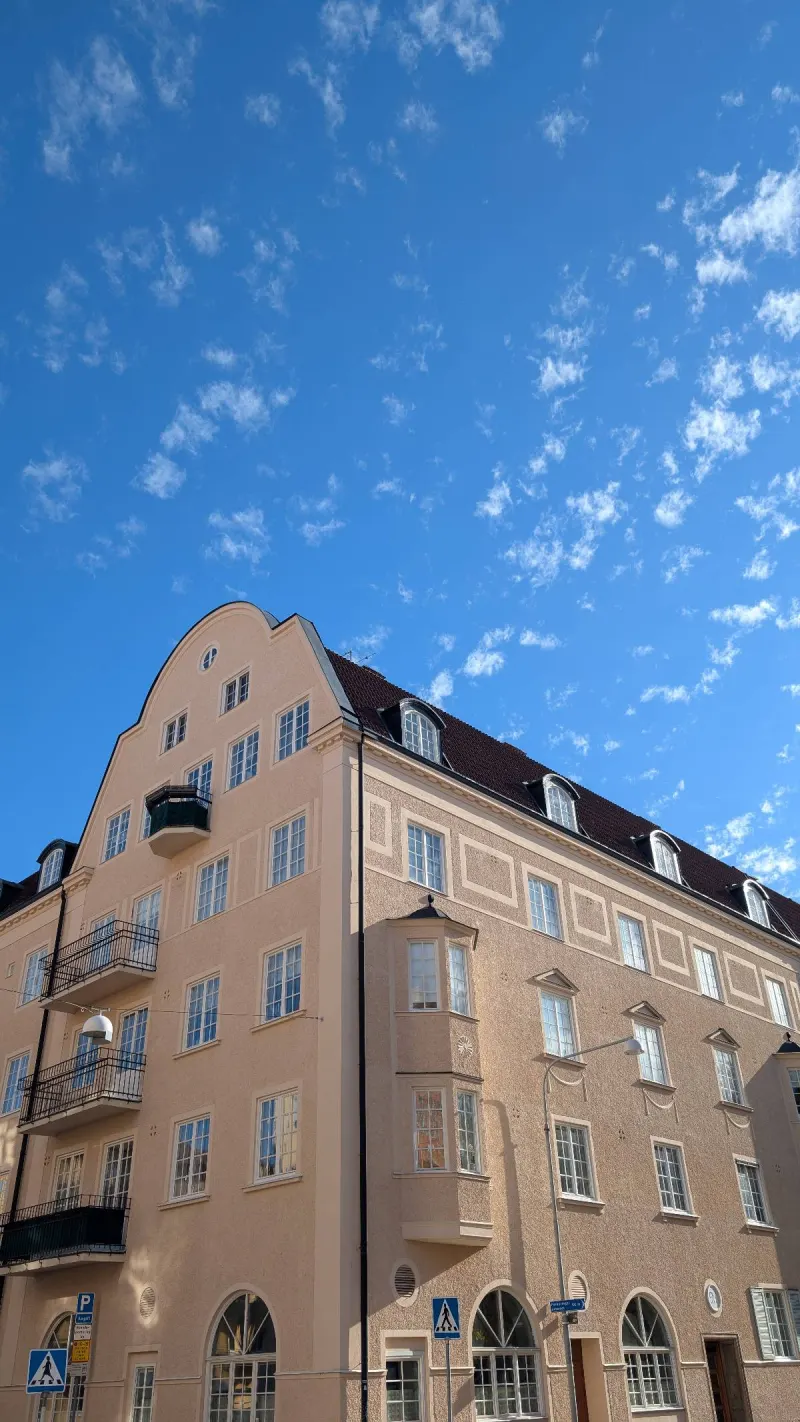 Platensgatan 21
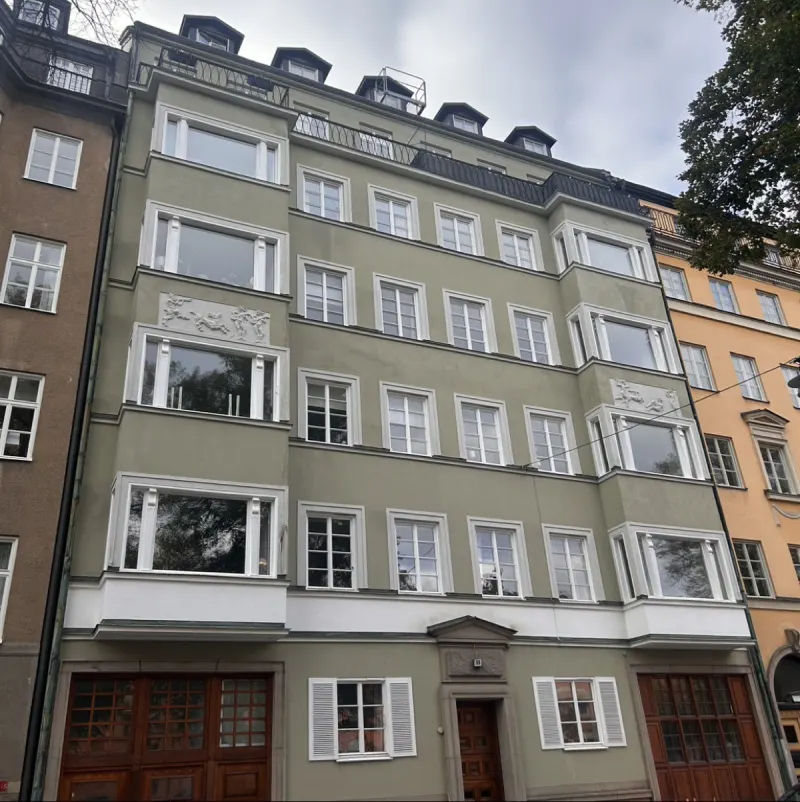 Linnégatan 96
07. Often confused with
Functionalism. Swedish Grace still has columns, symmetry and ornament, however little. Functionalism strips all of it away.
Sources
- lex.dk (Den Store Danske): "Sverige – arkitektur – 1850 til i dag"
- Henrik O. Andersson m.fl.: Nordisk klassicism 1910–30 (Helsingfors, 1984)
- Pontus Bovin: Landshövdingehusets bebyggelsehistoria (Uppsala universitet, Campus Gotland, 2023)
- Gunnela Ivanov: Swedish grace – en svensk art déco (2017)
- Swedish Wikipedia: "Tjugotalsklassicism", "Skogskyrkogården"
- Cecilia Björk & Laila Reppen: Tidstypiskt – arkitekturdetaljer i flerbostadshus 1880–1980 (Svensk byggtjänst, 2016)