01. Industrialisation at full speed
Industry is older than the factory. At Engelsberg in Västmanland a blast furnace is built as early as the 14th century. In the 17th century Per Larsson Gyllenhöök takes over and invests in a new furnace and forge. The manor house is finished in 1746. The works grows to some fifty buildings – and closes in 1919. A whole ironworks community is left standing.
Then industry moves into the towns.
Norrköping. The Motala ström rushes through the centre, and its water has turned mills since the Middle Ages. Holmens bruk has stood by the river since the early 17th century. But the great leap comes later: most of the factories are built between 1850 and 1920. In the 1850s Holmens bruk raises the Cotton Spinning Mill – at the time the largest industrial building in town. Thousands spin and weave wool and cotton.
In 1917 Strykjärnet – "the Iron" – is finished on a rock in the river. Folke Bensow designs a textile mill in the classicist style.
Form follows light. The façades are red or yellow brick, with long rows of large windows. Inside, cast-iron columns, and later concrete, carry big open halls. Above the workshops rises the sawtooth roof, a row of steep glazed slopes that let in even daylight. The outside likes to borrow from the styles of the day – Neo-Renaissance, Gothic Revival or Art Nouveau.
Then it turns. By the 1950s the textile crisis is a fact, and in 1970 Norrköping's last woollen mill closes. In the early 1970s the factories stand empty. The town chooses to preserve rather than demolish. Today the old halls house a university, museums and a concert hall – and Strykjärnet becomes the Museum of Work.
02. How to spot it
- 1.Red or yellow brick
- 2.Long rows of large, identical windows
- 3.Sawtooth roofs over workshop halls
- 4.Tall chimneys
- 5.Cast-iron columns and open halls
03. The giveaway
The windows. Long rows of large, identical windows tell of a time when daylight was the factory's most important lamp.
Read the façade
- Sawtooth roof
- A tall chimney
- Rows of large windows
04. Architects and builders
- Folke Bensow (Strykjärnet in Norrköping)
05. Where to see it
- The Industrial Landscape, Norrköpingmost factories from 1850–1920
- Strykjärnet, Norrköping1917, now the Museum of Work
- Engelsberg Ironworks, FagerstaWorld Heritage Site since 1993
- Falun MineWorld Heritage Site since 2001
06. In the app
1 place in this style in Everyday Grandeur. Tap it to see it on the map.
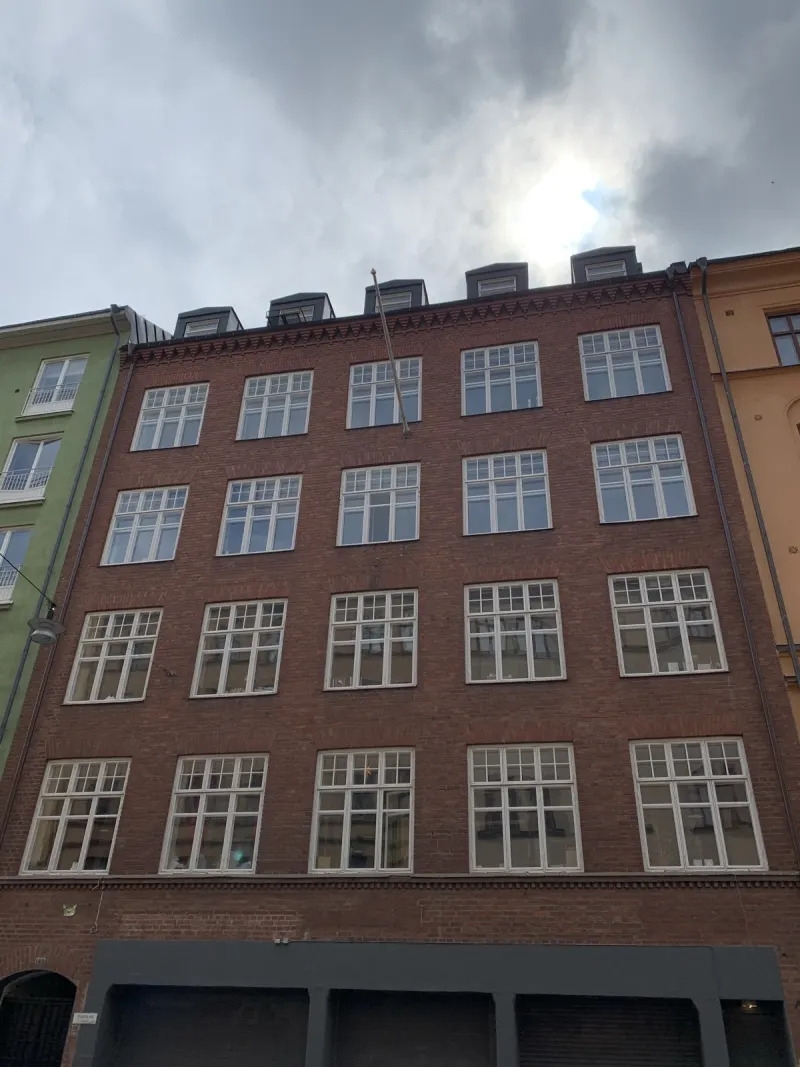 Åsögatan 142
07. Often confused with
Historicism. Many 1890s factories wear historicist dress – towers, gables and patterned brick. But behind the façade it is a factory: big windows, open halls and a plan built for machines.
Sources
- Norrköping Municipality: "Industrilandskapet i Norrköping" (2026 leaflet)
- Store norske leksikon: "Folke Bensow"
- Ekomuseum Bergslagen: "Engelsberg Ironworks World Heritage Site"
- County Administrative Board of Dalarna: "Världsarvet Falun"
- Getty Art & Architecture Thesaurus: "sawtooth roofs"
- Swedish National Heritage Board: Sweden's World Heritage Sites