01. Palaces for the people
At the start of the 1930s, the Soviet Union is still a laboratory for the avant-garde. But the competition for the Palace of Soviets in Moscow, 1931–1933, turns everything around: the winning line is monumental and classical. Constructivism is branded alien, and a new official style takes shape – in the East called socialist classicism, after the war often "Stalin Empire".
Façades take their forms from antiquity and the Renaissance, but the symbols are new: stars, ears of wheat, hammer and sickle. Everything must be grand – wide avenues, ceremonial façades and costly materials such as marble, granite and bronze.
After the Second World War the style reaches its peak. In Moscow the "Seven Sisters" are built, skyscrapers raised in 1947–1957; the largest, Lev Rudnev's main building of Moscow State University, is completed in 1953. The style is exported across the Eastern Bloc: the Palace of Culture and Science in Warsaw, also by Rudnev, opens in 1955. In Baku, Rudnev and Vladimir Munts raise Government House, built 1936–1952.
The end comes abruptly. In November 1955 Khrushchev issues his decree against "excesses" in building, and industrially built panel housing takes over.
02. How to spot it
- 1.Monumental, strictly symmetrical façades
- 2.Classical columns, cornices and spired towers
- 3.Soviet symbols: five-pointed stars, ears of wheat, hammer and sickle
- 4.Costly materials: marble, granite and bronze
- 5.Wide avenues and ceremonial squares
03. The giveaway
The star. A classical tower with a spire – and a five-pointed star at the top – is the signature of the Stalin era.
Read the façade
- The five-pointed star
- The tower and spire
- Small towers on the wings
- Classical columns
04. Architects and builders
- Boris Iofan
- Lev Rudnev
- Alexey Sjtjusev
- Ivan Zjoltovskij
05. Where to see it
- The Seven Sisters, Moscow1947–1957
- Main building of Moscow State UniversityLev Rudnev, 1953
- Palace of Culture and Science, WarsawLev Rudnev, 1955
- Government House, BakuLev Rudnev and Vladimir Munts, 1936–1952
06. In the app
4 places in this style in Everyday Grandeur, added by the app's users. Tap a place to see it on the map.
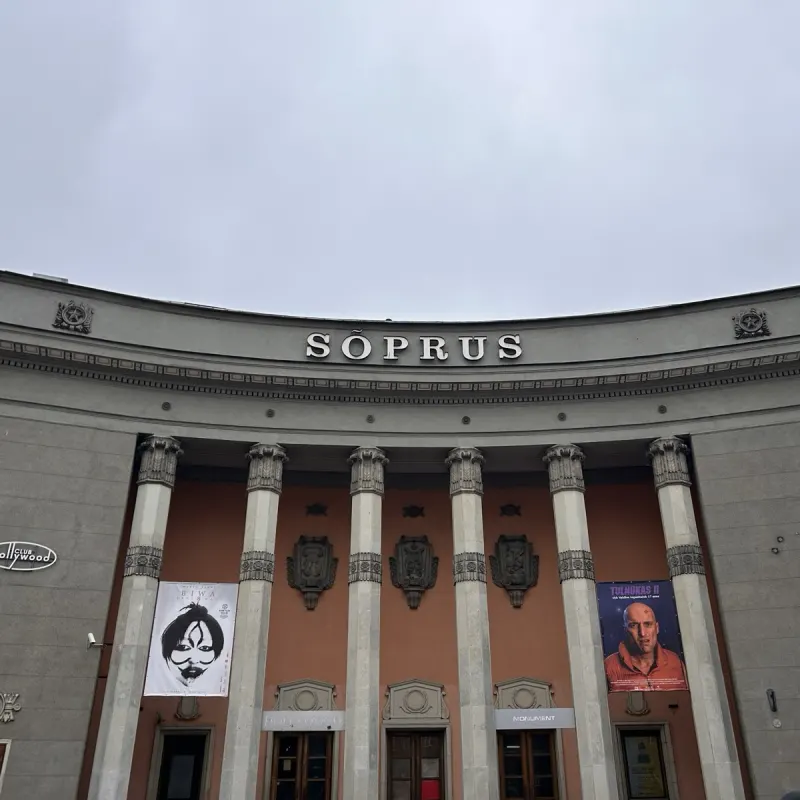 SõprusTallinn · 1955 · Friedrich WendachPhoto: @Pontus
- Nizami Museum of Azerbaijani LiteratureBakı · 1850 · Gasim bey HajibababeyovAdded by: @PrussianPerson
- Government HouseBaku · 1936 · Lev Rudnev, Vladimir MuntaAdded by: @PrussianPerson
- Azerbaijani Museum CentreBakı · 1955 · Hasan MajidovAdded by: @PrussianPerson
07. Often confused with
Neoclassicism. The same columns and pediments, but 18th- and 19th-century Neoclassicism is restrained; socialist classicism is lavish and full of political symbols. Art Deco. Moscow's setback towers resemble New York's skyscrapers – but the decoration is classical, not geometric.
Sources
- Wikipedia (en): "Stalinist architecture", "Seven Sisters (Moscow)", "Palace of Culture and Science", "Government House, Baku"